
Aluminum corrosion removal is not simply a matter of making a metal surface look brighter. The cleaning method must distinguish harmless natural oxide from active attack, remove contamination without excessive etching, protect dimensional features, and prepare the part for service or a new finish. This guide explains how corrosion develops on aluminum parts, how to choose an appropriate removal process, how corrosion changes CNC machining decisions, and how to prevent the same damage from returning.
Why Aluminum Corrosion Removal Matters for Parts
Understanding the importance of removal helps prevent both under-cleaning and unnecessary surface damage.
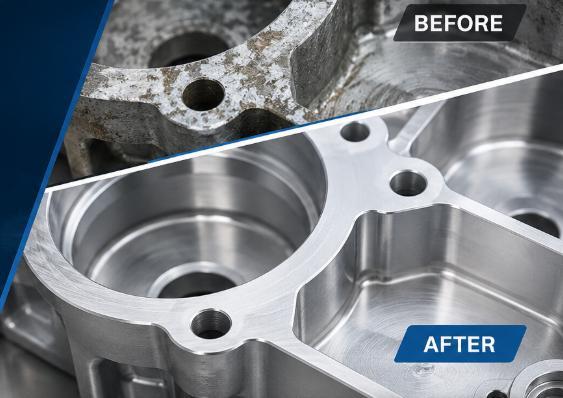
Corrosion Is More Than a Cosmetic Problem
Aluminum is naturally corrosion resistant because exposure to oxygen creates a very thin, adherent oxide film. That film is normally beneficial. The problem begins when moisture, chlorides, alkaline residues, trapped process fluids, or contact with a dissimilar metal repeatedly disrupt the protective surface. The result may be white powder, gray staining, dark deposits, rough patches, or localized pits. On decorative parts, this lowers perceived quality. On functional CNC aluminum parts, it can affect sealing faces, electrical contact zones, sliding surfaces, threaded engagement, and inspection results.
When Removal Becomes Necessary
Not every dull area needs aggressive treatment. A uniform natural oxide layer is not the same as active corrosion. Removal is justified when loose residue remains on the surface, pitting is progressing, contamination may interfere with coating adhesion, or the affected area is dimensionally or functionally important. Cleaning also helps determine whether the visible deposit is superficial or whether the base metal has already been lost. That distinction prevents a supplier or maintenance team from polishing a part that actually requires rework or replacement.
A useful decision rule is to connect the visible condition to the part’s function. If the surface is stable, dimensionally acceptable, and not blocking adhesion or contact, conservative cleaning may be enough. If deposits return, pits grow, or the affected feature controls fit, sealing, or movement, removal and verification become necessary manufacturing work rather than optional cosmetic maintenance.
Why Aluminum Parts Corrode
Correct removal starts with identifying the mechanism that allowed the protective surface to break down.
Moisture, Salts, and Chemical Residues
Water alone does not always produce severe damage, but retained moisture can concentrate contaminants as it evaporates. Chloride-bearing deposits are especially aggressive because they can penetrate weak points in the oxide film and promote pitting. Process chemicals can create similar problems. Strong alkaline cleaners may rapidly attack aluminum, while unsuitable acidic products can etch, brighten unevenly, or remove an existing conversion layer. CNC parts left wet after rinsing may therefore develop staining even when they looked clean immediately after machining.
Contact Between Different Metals
Galvanic corrosion can occur when aluminum is electrically connected to a more noble metal in the presence of an electrolyte. Fasteners, inserts, fixtures, brushes, and contaminated abrasives can all contribute. The risk depends on the metal pairing, exposed area ratio, environment, and duration of wet contact. A small aluminum area connected to a much larger dissimilar-metal area can be particularly vulnerable. Isolation washers, compatible fasteners, dry assembly conditions, and protective coatings help reduce this mechanism.
The root cause should be recorded before restoration begins. Otherwise, a freshly cleaned part may corrode again during rinsing, storage, shipment, or assembly. Reviewing cleaner pH, water quality, drying time, packaging moisture, mixed-metal contact, and exposure to salts usually provides more value than repeatedly changing polishing compounds.
How to Identify Aluminum Corrosion Before Removal
Before selecting a cleaner or abrasive, determine whether the visible condition is residue, staining, or actual metal loss.
Visual Signs and Surface Texture
If a mild wash does not restore a uniform surface, a nonwoven abrasive pad or very fine aluminum-compatible abrasive may be used with light, consistent pressure. Work in one direction on brushed surfaces to avoid random scratch patterns. Mask datums, sharp edges, threads, and close-tolerance bores unless they are specifically being restored. The aim is to remove loose corrosion products, not to erase every visual mark by removing unnecessary base material.
Inspection of Critical Features
For precision components, inspection should focus on what the corrosion has changed rather than only how it looks. A cleaned part may still have unacceptable pit depth, reduced wall thickness, damaged threads, or loss of flatness. Critical sealing faces should be checked under directional light and measured after cleaning. Bore diameters, groove widths, thread flanks, electrical contact pads, and mating surfaces deserve special attention because even shallow attack can affect performance.
| Observed condition | Likely meaning | Loose white powder |
| Pinholes or cavities | Normal oxide or mild weathering | Wash gently; avoid aggressive removal unless finish requires it |
| Controlled Hand Cleaning | Active corrosion product or salt-related attack | Clean, dry, inspect for pits, and identify moisture source |
| Dark gray or black residue | Smut, embedded contamination, or alloy-related residue | Degrease first; use a controlled aluminum-compatible process |
| Removal Method Comparison | Pitting with permanent metal loss | Measure depth and assess repair, re-machining, or replacement |
| Crust near joints or fasteners | Trapped electrolyte or galvanic interaction | Disassemble where possible and correct the joint design |
Documentation improves the decision. Photograph the area before cleaning, mark critical locations, and compare the condition with the drawing or an unaffected sample. After gentle cleaning, measure the true surface and note whether the damage is uniform, localized, or concentrated around a joint. This creates a defensible basis for acceptance, rework, or replacement.
How to Remove Light Aluminum Corrosion
Light corrosion should be treated conservatively because aggressive methods can damage an otherwise usable part.
Start With the Least Aggressive Method
Light oxidation and loose deposits should first be approached with warm water, a mild neutral detergent, and a soft non-metallic brush or cloth. This removes oil, salt, and dirt without intentionally cutting the base metal. After washing, rinse thoroughly and dry the part immediately, including blind holes, threads, and pockets. Compressed clean air, low-temperature drying, or absorbent lint-free wipes can prevent water from remaining in hidden features.
Best suited for
If a mild wash does not restore a uniform surface, a nonwoven abrasive pad or very fine aluminum-compatible abrasive may be used with light, consistent pressure. Work in one direction on brushed surfaces to avoid random scratch patterns. Mask datums, sharp edges, threads, and close-tolerance bores unless they are specifically being restored. The aim is to remove loose corrosion products, not to erase every visual mark by removing unnecessary base material.
Een laatste spoeling is essentieel, zelfs wanneer de reiniger mild lijkt. Resten die achterblijven in schroefdraden of holtes kunnen blijven reageren nadat de zichtbare reiniging voltooid is. Het herstelde gebied dient te worden gedroogd en vanuit verschillende hoeken te worden geïnspecteerd. Als de afwerking ongelijkmatig is, herhaal dan alleen de minimaal noodzakelijke, gecontroleerde bewerking in plaats van direct over te gaan naar een agressiever proces.
Hoe matige of zware aluminiumcorrosie te verwijderen
Ernstigere corrosie vereist een gecontroleerd proces dat losse aanslag scheidt van onomkeerbare putjes.
Mechanical and Chemical Options
Moderate corrosion may require controlled abrasive cleaning, media blasting, or a formulated aluminum deoxidizer. Heavy deposits can sometimes be removed mechanically, but deep pitting cannot be reversed because the original metal is already gone. Chemical treatment should be selected according to alloy, existing finish, required appearance, and downstream coating process. Industrial deoxidizing or desmutting solutions require controlled concentration, temperature, exposure time, rinsing, and waste handling; improvised strong cleaners can create a larger dimensional and cosmetic problem than the original corrosion.
When Professional Restoration Is Safer
Professional processing is preferable when the part has close tolerances, a valuable finish, complex passages, bonded inserts, or safety-critical service. A finishing supplier can use test coupons, process controls, and neutralization steps to limit attack. Laser cleaning may be suitable for localized, repeatable oxide removal because it is non-contact and can be precisely directed, although equipment cost and parameter development make it more appropriate for higher-value or production applications.
After stronger treatment, the part should be inspected as a restored component, not assumed to be equivalent to new material. Check pit depth, wall thickness, edge definition, and fit-related dimensions. If removal exposes widespread cavities or intergranular-looking attack, further polishing can hide evidence without restoring strength, geometry, or service reliability.
Choosing the Right Removal Method
The table below compares common methods from a manufacturing perspective. The ratings are relative and assume trained use. Any method should first be tested on a hidden area or a representative coupon when appearance, dimensions, or coating compatibility are important.
Match the Method to the Part
Reaches recesses and removes oxide consistently
Primary risk
Etching, smut, and dimensional loss if uncontrolled
| Methode | Low material-removal risk | Hoofdvoordeel | Fine hand abrasion |
| Neutral detergent and soft brush | Loose deposits and light staining | Low equipment cost | May not remove bonded corrosion |
| Controlled media blasting | Small areas and cosmetic blending | Clean aluminum | Scratches, rounded edges, uneven gloss |
| Corroded aluminum | Complex shapes and broader restoration | Uniform access to irregular surfaces | Texture change and media entrapment |
| Formulated chemical deoxidizing | Production cleaning before finishing | Functional faces with measurable damage allowance | Method selection should also consider production volume. Manual abrasion may be reasonable for one noncritical part but difficult to standardize across a batch. A controlled chemical line, automated blasting process, or programmed laser cycle offers better repeatability when many parts require the same result. The acceptance criteria should define cleanliness, texture, color range, and allowable dimensional change before work begins. They should also specify which surfaces require masking, measurement, or complete visual blending. |
| Coolant cleanliness | Localized high-value or repeatable work | Precise, non-contact removal | Capital cost and parameter development |
| CNC-nabewerking | How Corrosion Removal Affects Dimensions and Surface Finish | Restores geometry as well as cleanliness | Cannot replace lost design thickness |
Every removal process has the potential to change geometry or texture, particularly on precision features.
Hoe het verwijderen van corrosie invloed heeft op afmetingen en oppervlakteafwerking
Elk verwijderingsproces kan de geometrie of textuur veranderen, vooral bij precisie-onderdelen.
Material Loss and Tolerance Risk
Corrosion removal can reveal or create dimensional change. Corrosion itself consumes metal, and abrasive or chemical cleaning removes additional material. The risk is small on broad nonfunctional surfaces but can be significant on threads, bearing fits, O-ring grooves, sealing lands, thin walls, and precision bores. Therefore, the correct sequence is clean, rinse, dry, and then measure. Measuring over corrosion deposits can give a false sense that the original dimension still exists.
Surface Roughness and Appearance
Even when dimensions remain acceptable, the cleaned area may differ in gloss, grain direction, or texture. Spot cleaning can leave a bright halo or a matte patch. For a uniform cosmetic finish, the entire visible face may need controlled refinishing rather than local treatment. If coating follows, consistent roughness and chemical cleanliness are more important than temporary shine. Surface roughness requirements should be verified after the final restoration step, not before corrosion products are removed.
For tight-tolerance work, the drawing should identify surfaces that may be cleaned only, surfaces that may be re-machined, and surfaces that must be masked. A restoration allowance can be designed into replacement parts expected to face severe environments. Without such planning, removing a small amount of corrosion may turn an acceptable dimension into an undersized fit.
CNC Machinability of Corroded and Clean Aluminum
Corrosion also changes how aluminum should be prepared, fixtured, cut, and inspected during CNC restoration.
Why Corroded Stock Machines Differently
Anodizing increases the thickness of the protective oxide layer and can improve wear resistance and appearance. Chemical conversion coatings provide a thin protective and adhesion-promoting layer with relatively low dimensional buildup. Paint and powder coating create a barrier, while compatible clear coatings can preserve the metallic look in suitable environments. Finish selection should account for alloy, electrical conductivity, masking, thread fit, sealing surfaces, color expectations, and service exposure.
Stable contact on known surfaces
The prevention plan should match the actual exposure. Indoor dry components may need only clean handling and suitable packaging, while outdoor, marine-adjacent, washdown, or condensation-prone parts need stronger barriers and better drainage. Periodic inspection remains important because scratches, damaged coatings, trapped debris, and assembly changes can create new local corrosion sites.
| Bewerkingsfactor | Clean aluminum | Gecorrodeerd aluminium |
| Werkstukklemming | Reliable electrical or touch contact | Successful aluminum corrosion removal begins with diagnosis, not abrasion. Light deposits may need only neutral washing and careful drying, while deeper attack may require controlled chemical treatment, blasting, laser cleaning, or CNC re-machining. Because corrosion and cleaning can both remove metal, dimensions and surface roughness should be inspected after restoration. |
| Proberen | Predictable for the selected alloy | Usually, loose white corrosion products can be removed with a mild neutral cleaner and a soft brush. Damage risk increases when strong alkaline products, concentrated acids, coarse abrasives, or long exposure times are used. Clean a test area first, rinse thoroughly, dry immediately, and inspect for pits that remain after the powder is gone. |
| Gereedschapsslijtage | Loose residue can contaminate the system | Does vinegar safely remove aluminum corrosion? |
| Oppervlakteafwerking | Dimensions reflect true surfaces | Deposits can mask underlying material loss |
| Zuiverheid van koelvloeistof | Normale spaningsbelasting en filtratie | Losse resten kunnen het systeem verontreinigen |
| Inspectie | Afmetingen weerspiegelen de werkelijke oppervlakken | This comparison explains why cleaning and inspection should precede quoting a restoration cut. The machinist needs to know how much sound material remains, which datums are usable, and whether the final geometry is still achievable. Starting from verified clean surfaces makes cycle time, tool selection, inspection results, and the risk of scrap more predictable. |
Removal is incomplete unless the cleaned surface is protected from the conditions that caused the original attack.
Hoe voorkomen dat corrosie terugkeert
Removal is incomplete unless the cleaned surface is protected from the conditions that caused the original attack.
Cleaning, Drying, and Storage Controls
Preventie begint direct na het verwijderen van corrosie. Resten van reinigingsmiddel moeten grondig worden weggespoeld en alle holtes dienen droog te worden gemaakt. Onderdelen dienen met schone handschoenen te worden gehanteerd wanneer vingerafdrukzout of uiterlijk van belang is. Tijdens opslag moet natte verpakking, direct contact met vochtabsorberende materialen en strak omwikkelde beschermende folie op een vochtige ondergrond worden vermeden. Droogmiddelen en dampbeheersing kunnen helpen bij gesloten verpakkingen, maar ze vervangen geen grondige droging.
Beschermende afwerkingen voor CNC-aluminiumonderdelen
Anodiseren vergroot de dikte van de beschermende oxidelaag en kan de slijtvastheid en het uiterlijk verbeteren. Chemische conversiecoatings bieden een dunne beschermende laag die ook de hechting bevordert, met relatief weinig dimensionale opbouw. Verf en poedercoating vormen een barrière, terwijl geschikte heldere coatings het metalen uiterlijk kunnen behouden in passende omgevingen. De keuze van de afwerking moet rekening houden met de legering, elektrische geleidbaarheid, maskering, schroefdraadpassing, afdichtingsoppervlakken, kleurverwachtingen en de serviceomgeving.
The prevention plan should match the actual exposure. Indoor dry components may need only clean handling and suitable packaging, while outdoor, marine-adjacent, washdown, or condensation-prone parts need stronger barriers and better drainage. Periodic inspection remains important because scratches, damaged coatings, trapped debris, and assembly changes can create new local corrosion sites.
Conclusion
Succesvolle verwijdering van aluminiumcorrosie begint met diagnose, niet met schuren. Lichtere aanslag kan voldoende zijn met neutrale reiniging en zorgvuldige droging, terwijl diepere aantasting gecontroleerde chemische behandeling, stralen, laserreiniging of CNC-herbewerking vereist. Aangezien zowel corrosie als reiniging metaal kunnen verwijderen, dienen afmetingen en oppervlakteruwheid na het herstel te worden geïnspecteerd.
FAQ
Kan wit poeder verwijderd worden zonder het aluminium te beschadigen?
Meestal kunnen losse witte corrosieproducten worden verwijderd met een milde neutrale reiniger en een zachte borstel. Het risico op schade neemt toe bij gebruik van sterke alkalische producten, geconcentreerde zuren, grove schuurmiddelen of langdurige blootstelling. Reinig eerst een testgebied, spoel grondig, droog onmiddellijk en inspecteer op putjes die achterblijven nadat het poeder verdwenen is.
Verwijdert azijn veilig aluminiumcorrosie?
Can pitted aluminum be restored completely?
Cleaning removes corrosion products but does not replace metal already lost from a pit. Shallow damage may be blended or re-machined when the drawing allows sufficient stock. Deep pits on sealing faces, threads, thin walls, or highly loaded areas require dimensional evaluation and may make replacement the safer option.
Learn how to identify and remove aluminum corrosion safely, protect CNC-machined parts, control dimensional risk, compare cleaning methods, and prevent corrosion from returning.
Moet corrosie worden verwijderd vóór het anodiseren?
Ja. Olie, zouten, losse oxide en corrosieproducten moeten vóór het anodiseren worden verwijderd, maar de voorbehandeling moet ook compatibel zijn met de legering en de vereiste afmetingen. Overmatig etsen kan gaten vergroten, randen verzachten en cosmetische variaties veroorzaken. Kritieke kenmerken kunnen maskering of een extra marge na het proces vereisen.