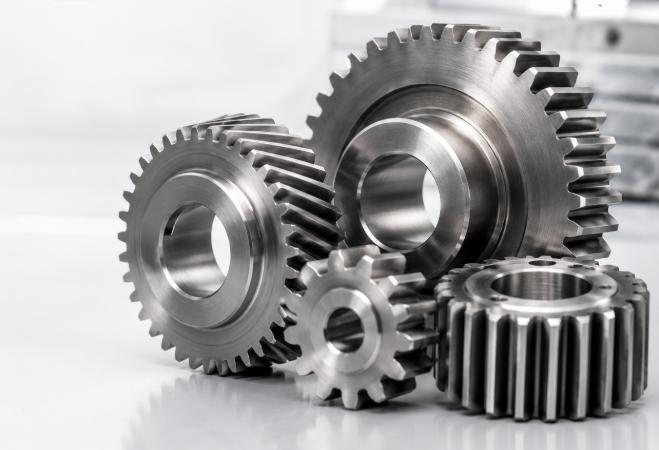
Gears are precision power transmission components used to change speed, torque, motion direction, or synchronization inside mechanical assemblies. For buyers searching for custom CNC gears, the real question is rarely only “can this gear be machined?” It is usually whether the gear can run quietly, mesh correctly, survive load, fit an existing shaft or gearbox, and be produced economically in the required quantity. CNC machining is often selected when a gear is not a simple catalog item, when a worn part must be replaced, or when the design needs a special bore, hub, keyway, tooth count, module, pressure angle, or material. This guide explains where gears are used, which gear features are commonly CNC machined, how materials affect machinability, what finishing is needed, and what engineers should consider before ordering a custom machined gear.
What Are Gears and What Do They Do?
A gear is a toothed rotating component that works with another gear, rack, shaft, or worm to transmit mechanical motion. The teeth are not decorative details; they are engineered contact surfaces. Their geometry controls how force moves from one component to another. In most mechanical systems, gears help designers convert motor output into useful movement. A small motor can drive a larger load through a reduction gear set, a shaft can change direction through bevel gears, and synchronized machinery can keep two motions timed through matched gears.

Core Function of a Gear
The most common function of a gear is to transfer torque while controlling speed. When a small gear drives a larger gear, output speed decreases and torque increases. When a larger gear drives a smaller gear, the system gains speed but loses torque. Gear teeth also keep motion positive, which means there is less slip than belt or friction drives. This is why gears are used in equipment that needs repeatable positioning, stable timing, or controlled mechanical advantage.
Common Gear Types
Different gear types solve different motion problems. A spur gear is simple and efficient for parallel shafts. A helical gear runs more smoothly because its angled teeth engage gradually. A bevel or miter gear changes the direction of power between intersecting shafts. A worm gear creates large speed reduction in a compact space. Rack and pinion systems turn rotary motion into linear motion. These types may look similar from a distance, but their CNC machining requirements, inspection methods, and finishing needs can be very different.
- Spur gears for simple parallel-shaft power transmission.
- Helical gears for smoother and quieter running.
- Bevel and miter gears for changing shaft direction.
- Worm gears for compact reduction and self-locking-style motion in some designs.
- Rack and pinion systems for linear movement.
Where Are CNC Machined Gears Used?
CNC machined gears appear in both industrial and smaller mechanical assemblies. They are commonly found in automation equipment, robotics, packaging machinery, medical devices, agricultural equipment, machine tools, testing fixtures, pumps, conveyors, and custom mechanisms. In these applications, the gear may be part of a gearbox, actuator, timing mechanism, reducer, indexing unit, or motion conversion assembly. The reason gears remain so widely used is simple: they provide controlled mechanical movement in a compact and durable form.
Industrial Equipment and Automation
In industrial machinery, gears are often expected to run for long periods under repeatable loads. A custom gear may be needed when the equipment has a nonstandard shaft size, an old gearbox, or a special ratio. Buyers often ask whether it is better to buy a catalog gear or machine a replacement. The answer depends on the geometry and load. If a standard gear has the correct tooth form, bore, face width, and material, it is usually cheaper. If the gear must match an obsolete assembly or a special housing, CNC machining becomes more practical.
Precision Devices and Custom Mechanisms
Smaller gears are also used in instruments, robotics, prototypes, and compact motion systems. These gears may need a lightweight body, fine teeth, thin walls, custom hubs, or integrated mounting features. CNC machining is useful because it can combine gear-related features with part-specific details in one controlled production route. Instead of buying a standard gear and modifying it by hand, the manufacturer can machine the blank, bore, shoulders, mounting holes, and tooth profile according to the drawing.
| Application Area | Common Gear Requirement | Why CNC Machining Helps |
| Automation equipment | Repeatable torque transfer and accurate timing | Custom ratios, bores, hubs, and inspection control |
| 机器人 | Compact size, low backlash, lightweight design | Fine features and integrated mounting geometry |
| Repair and legacy machinery | Replacement for worn or unavailable parts | Reverse engineering and one-off production |
| Pumps and drive units | Durable tooth contact and stable fit on shafts | Controlled bore, keyway, and surface finish |
| Test fixtures and prototypes | Fast design changes and small quantities | No dedicated mold or high-volume tooling required |
Are Gears Commonly Made by CNC Machining?
Many gears are made with CNC-related processes, but “CNC machining” can mean several different operations. A gear is not usually made by only cutting a round disk on a milling machine. The full process may include CNC turning for the blank, CNC milling for pockets or hubs, gear hobbing or shaping for teeth, broaching or wire EDM for internal details, heat treatment, and grinding or honing for final accuracy. For high-volume standard gears, dedicated gear machines are usually more efficient than general CNC milling. For custom gears, prototypes, repair parts, and complex gear bodies, CNC machining is very common.
Typical CNC Process Flow
A practical CNC gear workflow starts with the gear blank. The blank is usually turned to the correct outside diameter, bore, face width, and hub shape. If the gear needs weight reduction pockets, bolt holes, shoulders, or nonstandard mounting features, CNC milling may be added before or after tooth cutting. The teeth are then generated by hobbing, shaping, 5-axis milling, or form milling depending on gear type and quantity. After tooth cutting, the part may be deburred, heat treated, ground, and inspected.
When General CNC Milling Is Not Enough
A frequent misunderstanding is that any gear can be made by simply tilting a cutter or copying tooth spaces one by one. Straight spur gears can be form milled in some cases, especially for prototypes or larger tooth sizes. However, bevel gears, helical gears, internal gears, and precision transmission gears need correct tooth geometry. If the tooth contact pattern is wrong, the gear may run loudly, wear quickly, or fail under load. This is why professional gear production combines CNC machining with gear-specific processes and inspection.
| 工艺流程 | Used For | Best Fit |
| CNC车削 | Gear blanks, bores, hubs, shoulders | Nearly all machined gears |
| CNC铣削 | Pockets, bolt holes, lightening features, rough tooth spaces | Custom gear bodies and prototypes |
| Gear hobbing | External spur and helical teeth | Efficient production and accurate generated tooth forms |
| Gear shaping | Internal gears and external teeth near shoulders | Geometry that hobbing cannot reach |
| Grinding or honing | Final tooth accuracy and surface quality | High-load, quiet, or precision gears |
Materials Commonly Used for CNC Machined Gears
Material choice decides how the gear machines, how it wears, how much load it can carry, and whether it needs heat treatment or surface finishing. Before discussing individual materials, it is important to connect material selection with the working condition. A slow prototype gear may only need good dimensional accuracy. A loaded drive gear may need strength, tooth hardness, and controlled surface finish. A quiet mechanism may need a polymer or bronze gear. A corrosive or washdown environment may require stainless steel or engineering plastics.
Steel and Alloy Steel Gears
Carbon steel and alloy steel are common for gears that need strength, wear resistance, and reliable torque transmission. They are often CNC turned and gear cut before heat treatment. After hardening, critical gears may need grinding because heat treatment can cause distortion. Steel is not always the easiest gear material to finish, but it offers strong mechanical performance. For custom CNC gear manufacturing, steel is often selected for drive gears, pinions, shafts with integral gears, and repair parts where durability matters more than weight.
Stainless Steel, Aluminum, Bronze, and Plastics
Stainless steel is used when corrosion resistance is important, but it can be more demanding to machine because of work hardening and heat buildup. Aluminum gears are lightweight and easy to machine, making them useful for prototypes, light-duty mechanisms, and low-load assemblies. Bronze is valued for sliding contact and compatibility with worm gears. Engineering plastics such as POM, nylon, and PEEK can reduce noise and weight, although their thermal expansion and lower stiffness must be considered. These materials are often used where quiet running, low mass, or corrosion resistance is more important than maximum load.
| Material Group | 可加工性 | 典型用途 | Important Note |
| Carbon/alloy steel | Moderate; improves before hardening | Durable gears, pinions, drive components | May require heat treatment and final grinding |
| 不锈钢 | Moderate to difficult depending on grade | Corrosion-resistant gears | Control heat and work hardening |
| 铝 | 良好 | Light-duty gears, prototypes, lightweight assemblies | Tooth wear limits high-load use |
| 青铜 | Good to moderate | Worm wheels and sliding contact gears | Useful where friction behavior matters |
| Engineering plastics | Good but dimensionally sensitive | Quiet gears, light loads, compact devices | Allow for thermal expansion and moisture absorption |
Metal vs Plastic Gear CNC Machinability
A useful way to compare CNC gear machining is to separate metal gears and plastic gears. Both can be machined, but they behave very differently during cutting and in service. Metal gears usually provide higher strength, better tooth rigidity, and better load capacity. Plastic gears are lighter, quieter, and often easier to machine in small sizes, but they can deform if clamping, heat, or tool pressure is not controlled. This comparison helps buyers choose between performance, noise, weight, and cost.
Metal Gear Machinability
Metal gears require attention to cutting force, tool wear, burr formation, and heat treatment. Aluminum cuts quickly, but tooth wear may limit its use. Steel can be machined accurately in a softer condition, then hardened for wear resistance. Stainless steel requires stable tooling, coolant, and conservative parameters to prevent work hardening. Bronze generally machines well, but the exact alloy affects chip behavior. For precision metal gears, CNC machining is only part of the story; heat treatment, tooth grinding, and inspection may be essential to achieve long service life.
Plastic Gear Machinability
Plastic gears are often easier to cut but harder to hold dimensionally. Materials like POM and nylon can produce clean teeth, but they may move with temperature, moisture, or internal stress. Sharp tools, light cutting pressure, and proper fixturing are important. Plastic gears can be excellent for low-noise mechanisms, prototypes, and low-load devices. However, they are not a direct substitute for hardened steel gears in high-load drives. The machining plan must consider tooth deflection, burr-like edges, and post-machining dimensional stability.
| 影响因素 | Metal Gears | Plastic Gears |
| 强度 | Higher load capacity and tooth rigidity | Lower load capacity but good for light mechanisms |
| Machining heat | Needs coolant and tool wear control | Needs low heat to avoid softening or movement |
| Noise | Can be louder without finishing or lubrication | Usually quieter in light-duty systems |
| Finishing | Heat treatment, grinding, plating, coating, or polishing may apply | Deburring and stress control are usually more important |
| 最佳应用 | Power transmission and durable mechanical drives | Quiet, lightweight, low-load custom mechanisms |
Why Choose Custom CNC Gears Instead of Standard Gears?
Standard gears are ideal when the required module, tooth count, bore, width, material, and mounting style are available. They are usually cheaper and faster. Custom CNC gears become valuable when the standard part almost works but not quite. The difference may be a special hub, an unusual bore, a custom keyway, a nonstandard pressure angle, a special face width, a lightweight body, or a gear that must fit an existing assembly. In repair work, the original part may be obsolete, damaged, or unavailable, which makes reverse-engineered CNC gear manufacturing a practical option.
Customization Drivers
Users often choose CNC machining because they need a gear that matches their machine rather than forcing the machine to match a catalog gear. This is common in prototypes, legacy equipment, custom automation, and compact product designs. The gear may need to share space with bearings, retaining rings, shoulders, fasteners, or sensors. CNC machining can combine these details into one part, reducing extra modifications and improving fit.
Advantages Over Catalog Gears
The biggest advantage of a custom CNC gear is design control. Engineers can specify the material, heat treatment, tooth geometry, bore tolerance, surface finish, and inspection requirements. A catalog gear may still need secondary machining, which can add runout or reduce strength if not planned well. A custom gear can be designed from the beginning for the intended shaft, load, ratio, and assembly method. The tradeoff is cost: one-off precision gears can be expensive because setup, programming, gear cutting, inspection, and finishing are spread over very few parts.
- Custom bore, keyway, spline, or mounting hole pattern.
- Special tooth count, module, diametral pitch, face width, or ratio.
- Integrated hub, shoulder, lightweight pocket, or shaft feature.
- Material and heat treatment selected for actual load conditions.
- Reverse engineering for unavailable or obsolete equipment parts.
Which Gear Features Are CNC Machined?
A custom gear is more than a ring of teeth. Many of the features that make the gear fit and function are produced by CNC turning, milling, drilling, boring, broaching, and grinding. The tooth form is the most visible feature, but the bore, hub, faces, reference diameters, keyway, bolt holes, and side relief may be just as important. If these features are not concentric and square to the gear teeth, the gear can wobble, create uneven contact, or wear prematurely.
Tooth Profile and Gear Body
The tooth profile controls meshing. CNC gear hobbing, shaping, or form milling is selected according to the gear type and geometry. For custom gear bodies, CNC milling can create spokes, lightening pockets, chamfers, slots, or clearance features. These details can reduce weight, improve assembly clearance, or allow lubrication paths. However, aggressive weight reduction must not weaken the rim or change tooth stiffness too much.
Bore, Hub, Keyway, and Mounting Details
The bore and hub often decide whether the gear runs correctly. CNC boring can hold tight fit tolerances for shafts or bearings. Keyways and splines transfer torque from the shaft to the gear. Bolt holes or dowel holes locate the gear in assemblies. These features need accurate position and concentricity. For high-quality CNC machined gears, inspection should not only check tooth count and diameter; it should also verify bore runout, face squareness, keyway size, and tooth-to-bore relationship.
| 特征 | Common CNC Operation | Functional Purpose |
| Gear blank OD and faces | CNC车削 | Creates reference geometry and face width |
| Teeth | Hobbing, shaping, milling, or grinding | Transfers load through correct mesh |
| Bore | Drilling, boring, reaming, grinding | Controls shaft fit and concentricity |
| Keyway or spline | Broaching, shaping, EDM, milling | Transfers torque to shaft |
| Lightening pockets | CNC铣削 | Reduces weight and improves packaging |
| Chamfers and deburring | Milling, hand finishing, tumbling | Removes sharp edges and protects assembly |
CNC Machining Challenges for Gears
Gear machining is challenging because small errors are repeated around the entire circumference. A tiny indexing error can appear on every tooth. A rough tooth surface can create noise. Poor concentricity can create cyclic load variation. Heat treatment can move the part after it was machined accurately. For this reason, successful custom gear machining needs a stable process plan, not just a machine that can cut metal.
Tooth Accuracy and Indexing
Tooth spacing, involute geometry, lead, and profile accuracy are central to gear quality. When a gear is cut tooth by tooth on a mill, indexing accuracy becomes critical. For generated processes like hobbing, the relationship between tool rotation and workpiece rotation must be controlled. This is why dedicated gear cutting equipment is preferred for many precision gears. If the machine, fixture, or program introduces error, the gear may still look correct but fail to mesh smoothly.
Burrs, Heat, and Distortion
Burrs on tooth edges are common after cutting and can interfere with meshing or break loose during service. Heat can also change gear dimensions, especially in thin gears, stainless steel, and plastics. Heat treatment adds another layer of difficulty because hardening may distort the bore, faces, and tooth geometry. The solution is to leave grinding allowance when needed, use controlled heat treatment, and finish critical surfaces after hardening. For plastic gears, the priority is avoiding clamping distortion and heat buildup during machining.
Solutions That Improve Gear Quality
Reliable gear production usually depends on matching the process to the accuracy requirement. A prototype gear can sometimes be form milled and tested. A production gear for quiet running may need hobbing, shaving, grinding, or honing. A high-load gear may need controlled material certification and heat treatment. Inspection should include tooth measurement, bore size, runout, surface condition, and fit with the mating gear. Good communication about load, speed, lubrication, and noise expectations helps the manufacturer choose the right process.
- Use accurate blanks and maintain concentricity from turning to tooth cutting.
- Choose hobbing or shaping when generated tooth accuracy is required.
- Control burrs at tooth edges and keyways before assembly.
- Plan heat treatment and final grinding when tooth hardness is required.
- Inspect the gear against the mating component, not only as a standalone part.
Surface Treatment and Finishing for CNC Machined Gears
Not every CNC machined gear needs a surface treatment, but nearly every gear needs some form of finishing. The difference matters. Deburring, chamfering, grinding, honing, or polishing may be required to make the gear safe and functional. Surface treatment, such as coating or plating, is selected when the gear needs better wear resistance, corrosion protection, reduced friction, or improved appearance. The decision depends on material, load, lubrication, working environment, and expected service life.
When Surface Treatment May Not Be Needed
A gear may not need additional surface treatment if the base material already meets the working condition, the gear operates in a clean and lubricated environment, and the load is light. For example, some plastic gears only require clean machining and deburring. Some aluminum prototype gears may be used as-machined for short-term testing. Some stainless steel gears may be left untreated when corrosion resistance is already sufficient. In these cases, unnecessary coating can change dimensions or tooth contact.
When Surface Treatment Is Needed
Surface treatment becomes important when the gear faces wear, corrosion, high contact stress, or demanding service conditions. Heat treatment is often used for steel gears to increase tooth hardness and fatigue resistance. Black oxide or phosphate may be selected for mild corrosion protection and oil retention on steel parts. Electroless nickel plating can improve corrosion resistance and provide a uniform coating on complex shapes, but thickness must be controlled because gear teeth are precision features.
Common Finishing Options
Three common options are heat treatment, black oxide or phosphate, and electroless nickel plating. Heat treatment improves wear resistance and strength for steel gears but may require final grinding. Black oxide or phosphate is relatively thin and useful for steel parts where appearance and mild protection are needed. Electroless nickel plating is more protective and uniform, but it must be specified carefully to avoid changing tooth fit. For gears, finishing should always protect performance rather than simply improve appearance.
| Finishing Option | Main Benefit | Best Use |
| Heat treatment | Improves hardness, wear resistance, and fatigue performance | Steel gears under load |
| Black oxide or phosphate | Adds mild corrosion protection and improves oil retention | Steel gears in lubricated systems |
| 化学镀镍 | Uniform corrosion-resistant coating | Complex gears exposed to moisture or chemicals |
| Grinding or honing | Improves tooth accuracy and surface finish | Quiet, high-speed, or precision gears |
Common Questions Buyers Ask About Custom CNC Gears
Many gear projects begin with practical uncertainty. A buyer may have a worn sample, a sketch, or only a rough idea of the motion they need. Some questions are about manufacturing cost, while others are about design risk. Addressing these issues early prevents expensive revisions later.
Can a Gear Be Copied from an Old Part?
Yes, but copying a gear requires more than measuring outside diameter and counting teeth. The manufacturer must identify module or diametral pitch, pressure angle, tooth count, bore, face width, keyway, material, hardness, and any wear pattern. If the sample is badly worn, reverse engineering should include the mating gear or assembly. For critical parts, a drawing or 3D model should be created before production.
Should a Custom Gear Be Machined or Purchased?
A standard gear should be purchased when it matches the design and load requirements. Custom CNC machining is better when the gear is unavailable, obsolete, integrated with other features, or required in a special material. It is also useful for prototype testing, but buyers should expect higher unit cost for one-off precision gears because setup and inspection are significant.
Can Bevel or Miter Gears Be Cut Like Simple Spur Gears?
Not usually. Bevel and miter gears have tooth geometry designed for intersecting shafts, and their teeth are not simply straight spur teeth cut at an angle. They require correct taper, contact pattern, and alignment. For simple educational projects, a rough prototype may work at low load, but functional assemblies usually need proper bevel gear cutting, 5-axis machining, or a standard gear set.
结论
Gears are precision motion and power transmission parts, and CNC machining is most valuable when the gear must be custom, accurate, integrated, or unavailable as a standard item. A successful CNC machined gear depends on the right material, tooth process, bore accuracy, heat treatment plan, finishing method, and inspection. Standard gears are often best for simple needs, but custom CNC gears give engineers control over fit, performance, and assembly when catalog parts cannot meet the requirement.
常见问题
This FAQ answers the most common questions about custom CNC gears without repeating the full process details above. For accurate quoting, buyers should provide drawings, material requirements, gear data, quantity, tolerance expectations, and the working environment.
Are CNC machined gears expensive?
They can be expensive in low quantities because gear production includes setup, programming, blank machining, tooth cutting, deburring, inspection, and sometimes heat treatment or grinding. A single precision gear often costs much more than a catalog gear. However, custom machining is justified when the part is unavailable, obsolete, integrated with special features, or needed for a prototype that cannot use standard geometry.
What information is needed to quote a custom gear?
A good quote usually needs tooth count, module or diametral pitch, pressure angle, face width, bore size, keyway or spline details, material, tolerance, heat treatment, surface finish, quantity, and application conditions. If the gear is a replacement part, a sample and the mating gear can help identify the correct tooth form and contact requirements.
Can CNC machining make quiet gears?
CNC machining can support quiet gear operation, but noise depends on tooth accuracy, surface finish, material, alignment, backlash, lubrication, and load. Helical gears, ground teeth, controlled runout, and proper mating gear alignment can reduce noise. Plastic gears may also reduce sound in light-duty systems, but they must be designed for the actual load and environment.
Do all gears need heat treatment?
No. Heat treatment is mainly used when steel gears need higher tooth hardness, wear resistance, and fatigue strength. Light-duty aluminum, bronze, stainless steel, or plastic gears may not need hardening. When heat treatment is used, the process should account for possible distortion, and precision gears may require finish grinding after hardening.