
Sandblasting is a mechanical surface treatment that propels abrasive particles toward a part at controlled speed. On CNC machined components, it is commonly selected to remove light oxidation, reduce visible tool marks, create a uniform matte texture, or prepare a surface for a later coating. The process appears simple, but the final result depends on abrasive type, particle size, pressure, distance, angle, exposure time, material hardness, and part geometry. An aggressive setup can soften sharp edges, change surface roughness, expose casting or machining defects, or distort a thin wall. A controlled setup can produce a repeatable industrial finish without changing the basic geometry of a robust part. This guide explains how sandblasting works, what it does to precision CNC parts, and how engineers should specify and inspect the finish.
How Does Sandblasting Work?
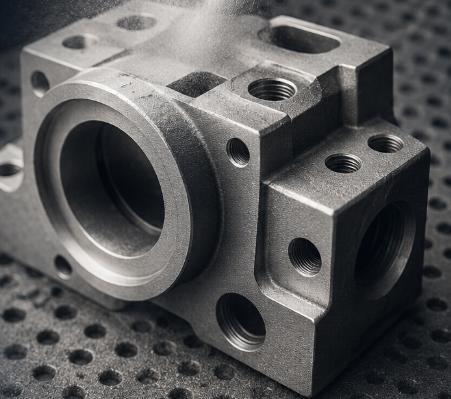
Sandblasting accelerates abrasive media through a nozzle and directs it at the workpiece. Compressed air is common, while automated systems move the part, the nozzle, or both for consistent coverage. Particle impacts cut, fracture, peen, or dislodge tiny amounts of material. Angular media cuts more aggressively and produces a sharper profile; rounded media peens the surface and creates a softer texture. Precision finishing shops commonly use aluminum oxide, glass bead, ceramic bead, garnet, plastic media, or other controlled abrasives rather than ordinary silica sand.
The Main Process Variables
A consistent finish requires the operator or automated recipe to control more than pressure alone. Two parts treated with the same abrasive can look different when the nozzle distance, impingement angle, dwell time, or media condition changes. Recycled media also becomes smaller and less sharp over time, which can gradually alter texture and production rate.
How Particle Impact Changes the Surface
Each impact creates a microscopic deformation or cut. Millions of overlapping impacts remove contamination and replace directional machining lines with a randomized surface pattern. Coarser, harder, and more angular particles generally remove material faster and leave a deeper texture. Finer or rounded particles are usually selected when appearance and consistency matter more than heavy cleaning.
- Pressure and air volume influence particle speed and removal rate.
- Media type, hardness, shape, and mesh size determine how aggressively the surface is attacked.
- Nozzle distance and angle affect coverage, edge rounding, and local roughness.
- Dwell time controls how much the original machining pattern remains visible.
- Masking protects threads, sealing faces, bearing seats, and cosmetic contrast areas.
What Does Sandblasting Do to CNC Machined Parts?
For CNC machined parts, sandblasting controls texture and prepares surfaces. It reduces visual contrast between milled, turned, and blended areas and can remove light scale, oxidation, staining, and minor contamination before a later finish. It does not correct dimensional errors, deep cutter marks, dents, chatter, or poor deburring. A matte surface may even reveal waviness because light reflects more evenly. Good results begin with a properly machined and deburred component.
Functional Effects on the Part
The textured surface may improve mechanical keying for a later coating, but an uncoated blasted surface is not automatically corrosion resistant. On carbon steel, removing rust without applying protection can leave a highly active surface that begins oxidizing quickly. On aluminum, blasting removes or disrupts the naturally formed oxide layer, which reforms in air but does not provide the same controlled protection as anodizing. The process can also influence friction, cleanability, and contact behavior, so functional surfaces need separate evaluation.
Where Sandblasting Adds Value
The finish is most useful on housings, brackets, covers, machine frames, fixtures, handles, and non-sealing exterior surfaces where a uniform industrial appearance is desired. It is less suitable as a blanket treatment for parts containing precision bores, optical surfaces, very thin walls, or passages that are difficult to clean.
| Typical Goal | What Sandblasting Can Do | What It Cannot Reliably Do |
| Uniform appearance | Reduce visual tool-path contrast and create matte texture | Hide deep scratches, dents, chatter, or poor blending |
| Surface cleaning | Remove light oxide, scale, and residue | Replace degreasing or final precision cleaning |
| Coating preparation | Use an approved physical sample or a controlled finish coupon for color and texture acceptance. | Inspect parts under the same lighting direction and intensity. |
| Deburring support | Critical Features That Should Be Protected | Replace controlled CNC deburring on critical edges |
Which Materials Are Suitable for Sandblasting?
Aluminum is frequently blasted to create a matte texture before clear or colored anodizing. Fine media and moderate pressure are preferred because soft grades can show uneven erosion, edge rounding, or distortion. Stainless steel can be blasted for cleaning or appearance, but embedded iron contamination must be avoided. Carbon steel responds well to aggressive cleaning, yet it normally needs prompt coating or another protective finish. Titanium can accept a matte blasted finish, although contamination control is important for high-performance applications. Copper and brass are softer and may darken, smear, or show an overly coarse texture when treated too aggressively.
Common CNC Materials and Their Response
Material selection does not determine the finish alone. Heat treatment, prior polishing, residual machining stress, and the presence of welds can create visible variation after blasting. Sample coupons or first-article parts are therefore useful when appearance is tightly controlled.
Material-Specific Controls
Matte cosmetic finish; preparation before anodizing
| Material | Precision bore or shaft | Belangrijkste risico | Aanbevolen controle |
| Aluminum | Clean compatible media and validated parameters | Smearing, color change, aggressive erosion | Fine media, lower pressure, even passes |
| Stainless steel | Cleaning and satin-matte appearance | Cross-contamination and later staining | Dedicated clean media and equipment |
| Koolstofstaal | What Color and Appearance Does Sandblasting Produce? | Rapid flash oxidation after cleaning | Coat promptly and control humidity |
| Titanium | Uniform matte texture | Sandblasting changes texture more than base color. Diffuse reflection makes the surface appear matte, dull, or satin. Aluminum often looks light silver-gray, stainless steel becomes gray satin, and carbon steel appears gray but may oxidize quickly if unprotected. Titanium develops a soft gray appearance, while copper alloys look muted and may darken naturally. Alloy, abrasive, particle size, pressure, and the original finish all affect the result. | Schone, compatibele media en gevalideerde parameters |
| The Main Cost Drivers | Decorative texture and oxide removal | Vervaging, kleurverandering, agressieve erosie | Low pressure and fine media |
Welke kleur en uitstraling ontstaat er bij zandstraalbewerking?
Zandstraalbewerking verandert de textuur meer dan de basiskleur. Diffuse reflectie maakt het oppervlak mat, dof of satijnachtig. Aluminium ziet er vaak licht zilvergrijs uit, roestvrij staal wordt grijs satijn, en koolstofstaal lijkt grijs maar kan snel oxideren als het niet beschermd is. Titanium krijgt een zacht grijze uitstraling, terwijl koperlegeringen gedempt ogen en van nature donkerder kunnen worden. De legering, het schuurmiddel, de deeltjesgrootte, de druk en de oorspronkelijke afwerking hebben allemaal invloed op het resultaat.
Why Two Batches May Look Different
Visual consistency is one of the most discussed challenges in cosmetic blasting. New media can be sharper than recycled media. A nozzle held closer to one area creates a deeper texture. Manual overlap patterns can produce clouds, stripes, or bright and dark zones. Parts machined from different material lots may also respond differently. A written callout such as “sandblast finish” is therefore incomplete when appearance matters. It should be supported by an approved sample, defined media, or an agreed roughness range.
Specifying a Repeatable Matte Finish
Een cosmetische specificatie moet de gewenste textuur en de te behandelen oppervlakken beschrijven, niet alleen de naam van het proces. De tekening kan beschermde oppervlakken, richtingsconsistentie, aanvaardbare kleurvariatie en informatie bevatten over of het gestraalde onderdeel later een geanodiseerde, geschilderde of poedergecoate afwerking zal krijgen.
- Gebruik een goedgekeurd fysiek monster of een gecontroleerd afwerkingsmonster voor acceptatie van kleur en textuur.
- Specificeer of gereedschapsstrepen na het stralen zichtbaar mogen blijven.
- Define protected surfaces and the required masking boundary.
- Keep media type and approximate particle size consistent between production batches.
- Inspecteer onderdelen onder dezelfde belichtingsrichting en -intensiteit.
How Does Sandblasting Affect Accuracy and Tolerances?
Zandstraalbewerking is geen precisieproces voor materiaalverwijdering, maar kan wel de afmetingen en geometrische kwaliteit beïnvloeden. Microscopisch snijden verwijdert materiaal, terwijl peening verhoogde pieken kan veroorzaken. Veranderingen kunnen onbeduidend zijn op algemene cosmetische oppervlakken, maar significant bij perspassingen, afdichtingsdiameters, lagerschalen, precisiegaten, dunne landen, scherpe randen en schroefdraad. Grof hoekig schuurmateriaal, hoge druk, korte afstand en lange verblijftijd verhogen het risico.
Kritieke kenmerken die beschermd moeten worden
Deep pockets and internal channels increase processing and cleaning time.
A subsequent coating adds separate preparation, handling, and inspection steps.
What Defects and Quality Problems Can Occur?
| Feature | Mogelijk effect | Preferred Design or Process Control |
| Striped or cloudy finish | A blasted surface has many microscopic valleys that can retain dust, fractured media, oil, or moisture. Reusing media across incompatible materials can embed foreign particles and cause later staining or corrosion. Cleaning should therefore be planned as part of the process, not treated as an optional final step. Dry filtered air, vacuum extraction, washing, ultrasonic cleaning, or validated flushing may be used depending on geometry and cleanliness requirements. | Exclude from blasting and mark on drawing |
| Schroefdraad | Edge rounding and altered visual boundary | Media selection affects both cycle time and operating cost. Durable recyclable media can reduce consumption, but it requires classification and maintenance to prevent inconsistent results. Tight appearance requirements add sampling and inspection time. Internal passages and blind pockets increase cleaning effort. Separate equipment for stainless steel, aluminum, or sensitive materials may also raise cost because it prevents cross-contamination but limits flexibility. |
| Sealing face | Loss of smoothness and leakage risk | Part quantity and racking efficiency determine setup cost per piece. |
| Scherpe rand | Randafvlakking en gewijzigde visuele grens | Voeg een duidelijke afschuining toe of bescherm de rand |
| Thin wall or flat panel | Uneven peening and distortion | Gebruik gebalanceerde passes, lagere intensiteit en speciale opspanning |
How Much Does Sandblasting Cost?
Sandblasting is often economical, but price is not based only on part size. Handling, masking, cleaning, quantity, media use, equipment time, inspection, and cosmetic requirements all matter. A small part with many threaded holes and sealing surfaces may cost more than a larger open bracket. Prototypes carry setup or minimum-lot charges, while repeat production becomes more efficient when parts are fixtured and processed together.
Finish too rough
De keuze van het schuurmiddel beïnvloedt zowel de cyclustijd als de operationele kosten. Duurzaam recyclebaar schuurmiddel kan het verbruik verminderen, maar vereist sortering en onderhoud om inconsistente resultaten te voorkomen. Strikte eisen ten aanzien van de uiterlijke verschijning voegen bemonsterings- en inspectietijd toe. Interne passages en blinde zakken vergroten de reinigingsinspanning. Aparte apparatuur voor roestvrij staal, aluminium of gevoelige materialen kan ook de kosten verhogen, omdat dit kruisbesmetting voorkomt maar de flexibiliteit beperkt.
How Design Choices Change the Quote
De goedkoopste onderdelen hebben een open geometrie, minimale maskering, toegankelijke oppervlakken en een brede acceptatiegrens voor textuur. De duurste onderdelen vereisen handmatige maskering rond vele kleine details, gecontroleerde bedekking in diepe uithollingen, speciale reiniging, individuele inspectie of nabewerking van cosmetische zones. Ingenieurs kunnen de kosten verlagen door het stralen te beperken tot de oppervlakken die het nodig hebben en door onnodig strenge visuele normen voor verborgen delen te vermijden.
- Het aantal onderdelen en de efficiëntie van de rekken bepalen de instelkosten per stuk.
- De complexiteit van de maskering speelt vaak een grotere rol dan de totale externe oppervlakte.
- Diepe zakken en interne kanalen verhogen de verwerkings- en reinigingstijd.
- Een referentiemonster voegt controle toe, maar vereist mogelijk goedkeuring van het eerste artikel.
- Een daaropvolgende coating voegt aparte stappen voor voorbereiding, hantering en inspectie toe.
Welke defecten en kwaliteitsproblemen kunnen zich voordoen?
Common defects include uneven texture, excessive roughness, rounded edges, residual abrasive, contamination, and distortion. Stripes, clouds, or gloss differences usually come from inconsistent distance, angle, overlap, flow, or dwell. Coarse media and high pressure create excessive roughness, while repeated impact rounds exposed corners. Residual particles are serious in threaded holes, narrow grooves, and blind cavities because they can enter an assembly or damage moving surfaces.
Contamination and Cleaning Risks
Een gestraalde oppervlakte bevat vele microscopische dalen die stof, gebroken straalmiddel, olie of vocht kunnen vasthouden. Het hergebruik van straalmiddel op niet-compatibele materialen kan vreemde deeltjes insluiten en later vlekken of corrosie veroorzaken. Reiniging dient daarom als onderdeel van het proces te worden gepland en niet als een optionele laatste stap te worden beschouwd. Afhankelijk van de geometrie en de eisen aan de reinheid kunnen droge gefilterde lucht, vacuümafzuiging, wassen, ultrasone reiniging of gevalideerde spoeling worden gebruikt.
Quality Controls That Prevent Rework
A robust quality plan combines parameter control with visual and dimensional inspection. Operators should monitor media condition, pressure, nozzle wear, distance, and part coverage. Inspectors should compare appearance with a reference sample, verify masking boundaries, check critical dimensions after finishing, and confirm that no abrasive remains in holes or passages.
| defect | Waarschijnlijke oorzaak | Corrective Action |
| Rounded corners | Uneven overlap, distance, or dwell | Use a fixed pattern, stable fixture, or automated motion |
| Embedded contamination | Coarse media, excessive pressure, long exposure | Use finer media and reduce intensity |
| Dirty or mixed media | Direct prolonged impact on exposed edges | Mask edges or reduce angle and dwell |
| Warped thin section | Choosing the Right Finish | Use dedicated clean media and equipment |
| Abrasive trapped inside part | Insufficient masking or cleaning access | Plug openings and add validated cleaning |
| Machined finish | Unbalanced impact and residual stress | Blast evenly on both sides at lower intensity |
What Design Rules Improve Sandblasted CNC Parts?
Design for sandblasting begins by separating cosmetic and functional surfaces. The drawing should show where matte texture is required and where the machined finish must remain. This prevents assumptions about bores, threads, sealing lands, contact areas, datums, or adhesive zones. Designers must also check access: deep slots, intersecting passages, and enclosed cavities can receive uneven coverage and retain particles.
Drawing Notes and Geometry Decisions
A useful drawing callout names the process, defines treated surfaces, references a sample or roughness target, and states the final inspection condition. It should also clarify whether minor edge softening is acceptable. Very sharp cosmetic edges rarely remain visually sharp after aggressive blasting, so a small controlled edge break can create a more repeatable appearance. Thin webs and broad flat panels should have enough stiffness to resist distortion during handling and impact.
Directional tool marks
Before releasing the drawing, review the relationship between blasting and every downstream operation. Blasting before anodizing can help create a uniform matte aluminum finish, but the anodizing process may emphasize alloy or texture variation. Blasting before coating can improve anchoring, yet an overly deep profile may remain visible through a thin coating. Blasting after final assembly should be avoided when particles could enter joints or mechanisms.
- Mark all no-blast surfaces directly on the drawing.
- Define edge-break requirements instead of relying on blasting to deburr.
- Confirm the sequence with anodizing, painting, powder coating, marking, and assembly.
- Require final inspection after all finishing operations on critical dimensions.
- Sandblasting Compared with Other CNC Surface Finishes
- Require final inspection after all finishing operations on critical dimensions.
Zandstralen vergeleken met andere CNC-oppervlaktebehandelingen
Sandblasting is frequently compared with bead blasting because both use propelled media and create matte surfaces. Angular abrasive is generally more aggressive, cleans faster, and produces a sharper profile. Rounded glass or ceramic beads tend to peen rather than cut, creating a smoother satin texture with less removal. Because suppliers sometimes use the terms loosely, drawings should identify the media and desired result instead of relying on the process name alone.
Comparison with Bead Blasting, Anodizing, and Powder Coating
Anodizing and powder coating are not direct substitutes for blasting. They add a converted or deposited protective layer, whereas blasting primarily changes texture and cleanliness. Blasting is often used before these finishes. On aluminum, bead blasting followed by anodizing is common when a uniform matte color is required. Powder coating can provide color, corrosion protection, and a thicker barrier, while blasting may be used first to clean the surface and create adhesion. A machined finish retains visible tool paths and sharp feature definition, which may be preferred for precision surfaces or lower cost.
Choosing the Right Finish
The correct choice depends on whether the priority is heavy cleaning, smooth cosmetic texture, corrosion resistance, color, coating thickness, dimensional control, or cost. Sandblasting is strongest as a preparation and texture process. Bead blasting is usually preferred for a softer cosmetic satin. Anodizing is selected for aluminum surface protection and color, while powder coating is chosen for a thicker colored barrier on suitable parts.
| Afwerking | Primaire doelstelling | Typische uitstraling | Tolerantieoverweging |
| Sandblasting | Cleaning, roughening, matte texture | Matte and relatively coarse | Mask critical features; can round edges |
| Stralen met kralen | Uniform cosmetic satin texture | Gladdere satijn-matte | Usually gentler, but still protect fits and seals |
| Machined Finish | Preserve as-cut geometry and tool pattern | Directionele gereedschapsstrepen | Best dimensional continuity; appearance varies by tool path |
| Anodizing | Protect and color aluminum | Clear or colored; matte or satin depending on pretreatment | Adds or converts a thin surface layer; account for fits |
| Powder coating | Color and barrier protection | Broad color and gloss options | Much thicker than blasting texture; mask precision areas |
Conclusion
Sandblasting can transform a CNC machined part from a visibly tooled component into a uniform matte product or a well-prepared base for a later coating. Its success depends on matching media and intensity to the material, protecting precision features, controlling visual standards, and removing every trace of abrasive after processing.
FAQ
Can Sandblasting Remove CNC Tool Marks?
It can reduce the visual contrast of light tool paths, but deep marks, chatter, dents, and blending errors may remain visible. Correct machining and deburring should come first.
Does Sandblasting Prevent Rust?
No. It removes rust and prepares the surface, but exposed carbon steel normally needs prompt coating or another protective finish.
Can Threads and Precision Holes Be Sandblasted?
They should usually be masked because texture changes and trapped abrasive can affect fit, sealing, measurement, and assembly.
Is Bead Blasting the Same as Sandblasting?
Both propel media at a surface, but rounded beads generally produce a smoother, less aggressive satin finish than angular abrasive.
Gerelateerde SEO-sleutelwoorden
The following keywords can support internal linking, image alt text, category pages, and future articles related to CNC surface finishing.
Primaire en long-tail zoekwoorden
Use the main phrase naturally and distribute supporting terms only where they match search intent.